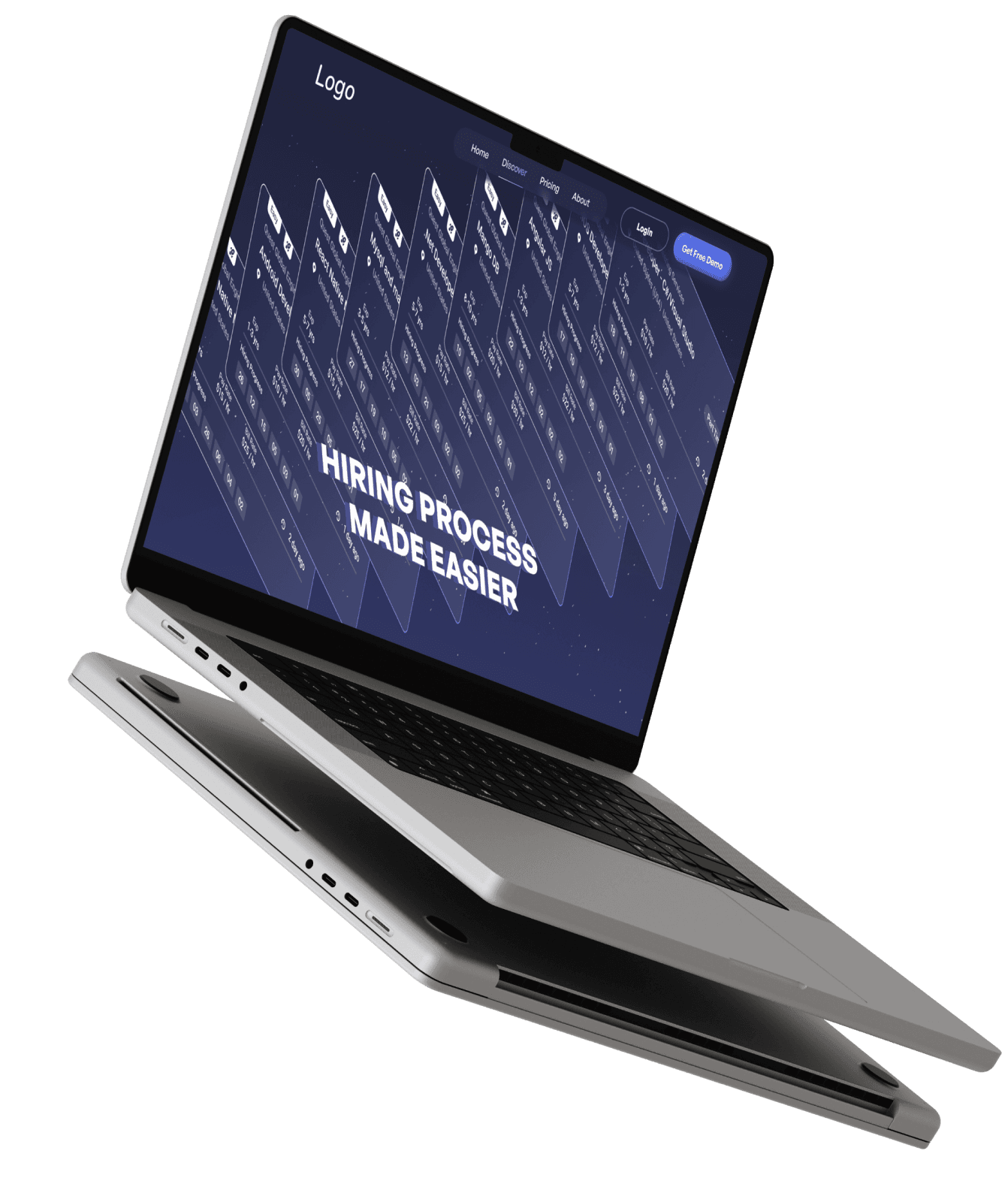
Design a Interactive ATS Software Landing Page for High-Conversion

Design a Interactive ATS Software Landing Page for High-Conversion

Design a Interactive ATS Software Landing Page for High-Conversion

Project Overview:
Project Overview:
Project Overview:

Designed an intuitive, high-impact landing page for an ATS software that transforms the hiring experience for recruiters. This visually engaging and conversion-driven website effectively highlights the software’s value, guiding users seamlessly from discovery to action. The ‘Discover’ page, an interactive showcase of the hiring process, enhances user engagement by illustrating each step dynamically, making recruitment effortless and efficient.

Target Group:
Target Group:
Target Group:

We target the global IT services market, streamlining and enhancing the hiring process for seamless recruitment.

Storytelling Website

Interaction Design

Watch the video below to experience the interactive Discover page.
User Research
User Research
User Research

To understand the pain points of recruiters and hiring managers, we conducted in-depth user interviews with both roles across small companies. Our goal was to uncover the root causes of scheduling delays, missed feedback, and lack of hiring process visibility.

Problem Statement
Problem Statement
Problem Statement

Recruiters and hiring managers at small companies struggle with fragmented tools, manual coordination, and lack of visibility into candidate progress, feedback, and analytics. This results in frequent rescheduling, delayed feedback, and missed opportunities with strong candidates — ultimately slowing down the hiring process.
From Research to Opportunities

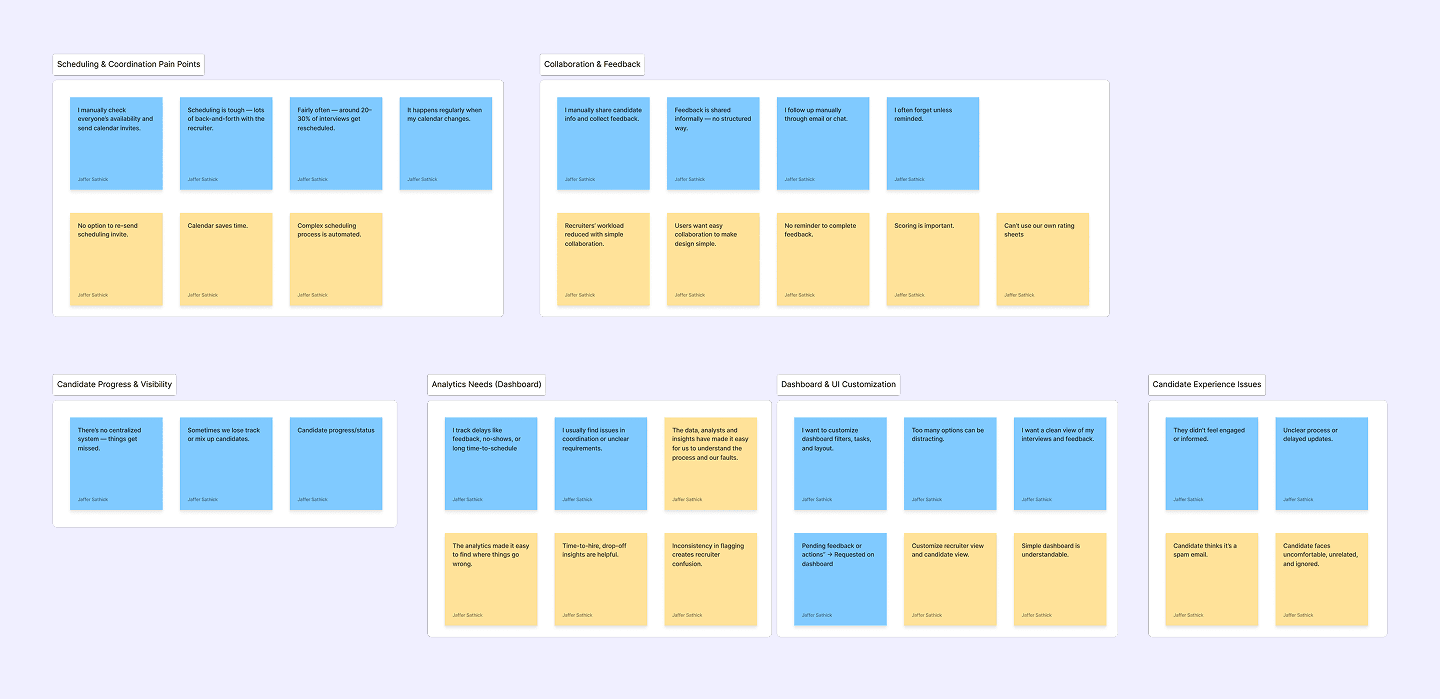
I interviewed 5 recruiters and 2 hiring managers in our internal team, I identified several recurring pain points that were slowing down the hiring process.

Teams were juggling multiple tools, facing frequent rescheduling, and struggling with delayed or missing feedback. Without a centralized way to track candidate progress, coordination suffered and strong candidates were sometimes lost.

This led me to explore key discovery questions:

  • How can a dashboard improve the current workflow if it’s not part of the product yet?

  • What hiring metrics matter most for tracking efficiency and candidate success?

  • Why does rescheduling occur so frequently, and how can it be reduced?

  • What data should be immediately visible to help recruiters take faster actions?

  • Why are hiring managers delaying feedback, and how can they be nudged to respond sooner?

  • What causes candidate drop-offs, and how can they be identified earlier?

This led me to explore key discovery questions:

  • How can a dashboard improve the current workflow if it’s not part of the product yet?

  • What hiring metrics matter most for tracking efficiency and candidate success?

  • Why does rescheduling occur so frequently, and how can it be reduced?

  • What data should be immediately visible to help recruiters take faster actions?

  • Why are hiring managers delaying feedback, and how can they be nudged to respond sooner?

  • What causes candidate drop-offs, and how can they be identified earlier?

Through in-depth interviews with recruiters and hiring managers, I identified several recurring pain points that were slowing down the hiring process.

Teams were juggling multiple tools, facing frequent rescheduling, and struggling with delayed or missing feedback. Without a centralized way to track candidate progress, coordination suffered and strong candidates were sometimes lost.

This led me to explore key discovery questions:

  • How can a dashboard improve the current workflow if it’s not part of the product yet?

  • What hiring metrics matter most for tracking efficiency and candidate success?

  • Why does rescheduling occur so frequently, and how can it be reduced?

  • What data should be immediately visible to help recruiters take faster actions?

  • Why are hiring managers delaying feedback, and how can they be nudged to respond sooner?

  • What causes candidate drop-offs, and how can they be identified earlier?

Insights
Insights
Insights

Recruiter: "20–30% of interviews get rescheduled.

Feedback is often delayed unless manually chased.

Some candidates drop out mid-pipeline.

Key Problems
Key Problems
Key Problems

Candidate Drop-off Reasons:

  • Missed emails

  • Long hiring process

  • Accepted other offers

  • Dissatisfaction with interview or company experience

Feedback Delay Reasons:

  • Not capturing feedback immediately

  • Forgetting over time

Solution & Design Decision

A set of focused features designed to streamline scheduling, improve candidate visibility, and provide actionable insights for faster, smarter hiring decisions.
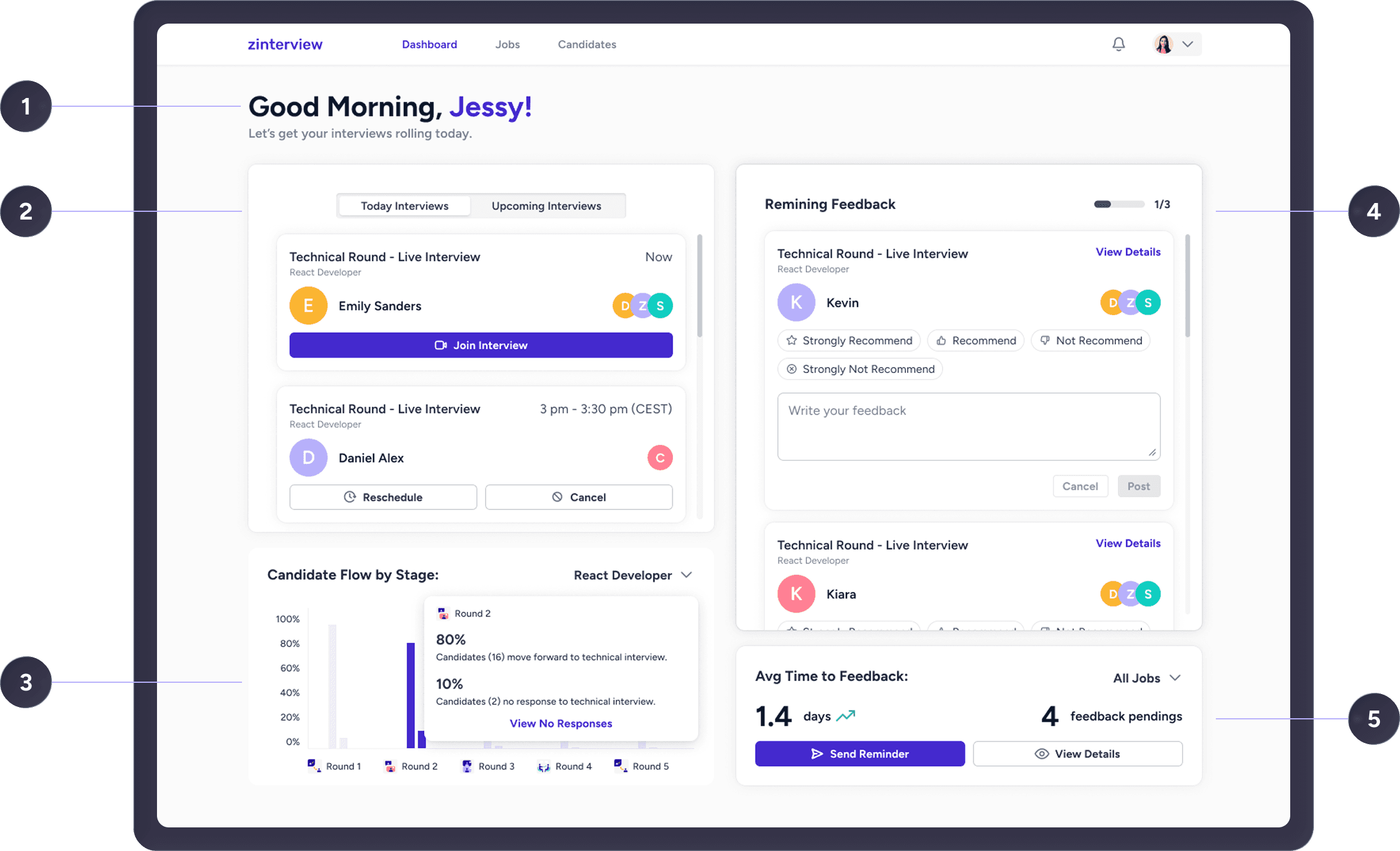
1

Personalized Greeting:

Personalized Greeting:

A personalized greeting on login creates a welcoming start, fostering connection and encourages a positive tone for the day’s recruitment tasks.

A personalized greeting on login creates a welcoming start, fostering connection and encourages a positive tone for the day’s recruitment tasks.

2

Quick Interview Actions:

Quick Interview Actions:

Tabbed navigation enables quick task switching between today’s and upcoming interviews, with inline actions for joining, rescheduling, or canceling, ensuring timely responses, preventing missed meetings, and reducing navigation steps.

Tabbed navigation enables quick task switching between today’s and upcoming interviews, with inline actions for joining, rescheduling, or canceling, ensuring timely responses, preventing missed meetings, and reducing navigation steps.

3

Stage conversion rates:

Stage conversion rates:

Visualize candidate drop-offs at each stage to help recruiters identify weak stage in the pipeline.

Visualize candidate drop-offs at each stage to help recruiters identify weak stage in the pipeline.

4

Feedback Turnaround Tracking:

Feedback Turnaround Tracking:

Track pending feedback counts and average response times to encourage timely reviewer input.

Track pending feedback counts and average response times to encourage timely reviewer input.

5

Feedback Nudges:

Feedback Nudges:

Display pending feedback to prompt action, keeping hiring managers actively engaged and enabling them to act quickly, ensuring a smoother hiring pipeline.

Display pending feedback to prompt action, keeping hiring managers actively engaged and enabling them to act quickly, ensuring a smoother hiring pipeline.

Usability Testing & Validation

Before Testing (Baseline)

  • Feedback Turnaround Time: Avg. 3–5 days per round

  • Candidate Drop-off Rate at different stages

After Testing (Results)

  • Reminder System: 80% found it useful

  • Drop-off Funnel: 60% identified drop-offs without assistance; 100% found it useful

  • Reduce feedback turnaround time <24hrs

  • Usability: 100% reported no usability issues

  • Rescheduling Effort: Reduce by 20%

  • CSAT: 92%

backgrount
18% Faster

Reduced feedback turnaround time

18% Faster

Reduced feedback turnaround time

0%

Reduced rescheduling effort

0%

Reduced rescheduling effort

0%

Reduce candidate drop-offs

0%

Reduce candidate drop-offs

  • Impact

Impact

background
18% Faster

Reduced feedback turnaround time

0%

Reduced rescheduling effort

0%

Reduce candidate drop-offs

Impact

Thank you for taking the time to read through my design process for the Zinterview.


I enjoyed solving these recruitment challenges and welcome any feedback, questions, or opportunities to collaborate.

Create a free website with Framer, the website builder loved by startups, designers and agencies.